Teaching Philosophy
My Personal Philosophy of Teaching Secondary Education
For my teaching philosophy, I have grown from years ago in my senior year writing my first-ever version. I have taken many courses, experienced teaching in the field, and gone through many different personal experiences. So I felt what better way of presenting my teaching philosophy than to just show everyone how I have thought over the years as I have written one version of my teaching philosophy in my senior year of high school to another version in college. Each will be titled with the appropriate date as well. No matter how I have changed through the years however, making sure my students are learning, and are comfortable, and feel safe in my classroom, are the top drivers to how I teach, and the things I implement in the classroom.
SENIOR YEAR - 2020
Philosophy of Education
I chose the quote because I agree with that statement. I can’t tell you the things from 3rd grade. I can’t remember and tell you exactly what we did, however, I can tell you about my 3rd-grade teacher, my 7th-grade English teacher, and my teachers in high school. Teachers have a lifelong impact on their students and I believe I should make sure I am a positive memory for them, that I was there for them, and that they always felt comfortable learning in my room and around me. I disagree with most thinking that teachers aren’t supposed to be friends. Now I don’t believe things should get super personal. I am not for that, however, I do believe if you can establish a calm, friendly, and comfortable relationship with your students, they will learn better, and in fact, respect you more. I want my students to succeed and they can not do that if they sigh or moan whenever they bring up my class with others; friends and their other teachers. I can care less about my peers' opinions about me as long as my kids enjoy coming to learn in my class and they are truly learning from me.
I believe the purpose of education is to make sure we teach future generations how to live in this world, how to make it a better place than the ones they were born into, and to reach their goals and dreams so they can live a happy life. For me personally, I want my kids to be happy. If they dread going to a certain class or coming to learn, they won’t learn, or it won’t stick. Kids may have a hard time at home, I don’t want them to drop out, and I don’t want kids to skip my class. They need to see learning can be enjoyable and see how it helps them. If they can have fun in my class and other classrooms and see how their learning is helping them, then they’ll be enlightened and always want to pursue a life full of learning. Even as adults we are learning something every day, and kids should grow up welcoming it and embracing it instead of pushing it away and going down a darker path.
I really think that teachers should be using less of that authoritarian style of learning at an older age. Coming from someone who is in high school, kids don’t want to be lectured, they don’t want to be treated like dogs. They want to have that interaction with their teachers and their peers. If teachers calm down a little bit on being strict or being super authoritarian I can bet they will see kids get higher engagement and higher test scores. The class needs to be about the kids. Or else why even have schools? Teachers need to be humble and realize it's bigger than themselves, it's bigger than just a 7-2 job. It’s about making sure the future generations of the world can keep this world afloat and that they can enjoy learning and be able to be successful in their lives. It needs to be about the students, let them figure out problems together, let them build their relationships, yes they will be taught but the best way of learning is doing something and learning from the outcomes. Classes should be taught with the students being the main focus at heart and let them work together in varieties of settings such as individually, in groups, or all together as a class, as they’ll learn in life they will have to do anyways. I believe teaching should be used in multiple methods such as cooperating with their peers and through lectures and projects. If you are making sure the kids work together, they are practicing and learning how our society works without them even knowing it. Lectures help them respect and learn from someone who may be older than them or more qualified and make sure they can be coachable, that they can listen to others and do what is told. You see these when students work together in groups and pick a leader themselves and work together to solve something and you can see them learning how to take orders and listen when they are told to write notes and ask questions, they are actively practicing those skills.
This level of teaching I believe requires selfless people. People who are educated beyond associates, and people that are not needy. This needs loving people, parents, and people who care about others who can see the bigger picture and are not selfish. Teachers need to make sure they consider how students have lives outside of school, and not every student is a superhero and will get everything done, not every student has a good life at home and there are students who will never tell you how bad they might have it or may be feeling. So teachers need to go into their classroom every day with an open mind and an open heart. They should expect their students to stay engaged and work productively most of the time with little to no behavioral issues IF the TEACHER is doing her job correctly with an open mind and an open heart for their students.
There is no set way to teach, and In my opinion, the only set way to teach is to make sure there’s 2 goals driving how it is done; making sure they learn and they’re happy. If you can make those 2 things happen, then you will have succeeded as a teacher, no matter how you got them to that point.
UNLV - 2022
Abstract
In this paper, I explain and navigate the difference between equity and equality; how it is important to see both but practice equity over the other, and why it is important to relate that towards education. Along with exploring the importance of equity, is also the importance of Social Justice and the role it plays hand in hand with equity-based teaching practices and pedagogies. Not only do others agree that equity-based education is important, but that it also works. As data shows that a significant number of EDU systems and educational leaderships are exploring and changing their models towards a more equitable and socially just education system. Besides that, it is also my own personal experiences that helped shape how I feel about social justice and equity in life and education.
Equity Teaching Philosophy
Introduction
This assignment differs from a usual teaching philosophy, as this pertains specifically to Equity and Social Justice. This consists of arguments and reasoning to explain my view on my own Equity Teaching Philosophy and why I believe it is important to understand and practice equitable teaching over equality in the classroom and in life. As I have already alluded to, I am in agreement that educators and students will benefit more from equity teaching pedagogies rather than from equality teaching. I myself am a student who is in school to become an educator, I believe strongly that equity works significantly better over equality-based practices.
Elements
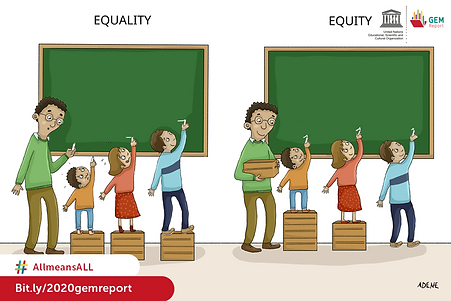
Equity vs. Equality
(Arendt, Hannah. Equity in Education, https://www.arisenetwork.eu/en/about-iniative/equity-education/.)
I chose my picture to represent equity versus equality because it's a more specific and applicable picture to the common equity versus equality crate and baseball picture. Originally reading too many issues that people wrote on that specific example, this one provides a more unique and applicable perspective in the world of education. It shows how every student gets to write on the board but is not truly able to reach it all the way. and is comfortable on the equality side where in the equity side, not only does every student have the chance to write on the board, but they get the opportunity to truly and comfortably be able to do so. Representing the issues that come with equality versus equity specifically in education as well in this example. This is important because equality assumes everyone is equal, comes from equal backgrounds, and has equal experiences in their lives compared to their peers and others, while we all know in reality that is just not true and fair to assume of people and of students.
Not every student comes from a wealthy background financially, emotionally, or even physically with nutrition and safety. This is why equality is so problematic in education, as it's not fair to assume, that just because students are given equal opportunities, they are done so without regard to the reality of each student’s life. Whether they have a family, have a secure place to live and sleep at night, eat 3 meals a day, or are loved at home. Not every student has those luxuries, and those are luxuries, in this day in age. So it is unfair, and unjust to treat everyone the same regardless of their backgrounds because we are still inherently treating them unfairly and not giving them the true opportunity to succeed compared to others in the class, school, county, and or nation.
Definition of Social Justice
For me, social justice is equality for all in respect to economics, politics, and rights.
“Social justice may be broadly understood as the fair and compassionate distribution of the fruits of economic growth” (United Nations). I feel this is important for educators to understand and be able to live by in their professions, as classrooms are where the next generation is taught values and morals and how to learn from the mistakes of others to provide a better future for themselves and others. They can learn how to improve our current systems in our country that are old and broken, to truly be able to make positive change in regard to social justice and equity, especially in education. Typically students are only taught surface-level multicultural education, like learning about Native Americans and the Trail of Tears, or “Thanksgiving”. taught not about the true horrors of the Atlantic Slave Trade and Christopher Columbus, but rather rated-G versions of their history in benefit to the white men and furthering the idea of patriarchy and the oppression of minorities; Or just calling it whitewashed versions of history.
Good teachers and educators see that it is not the right nor successful way to educate our students and not the right ideas, messages, or values to be taught/practiced in the classroom regarding social justice and equity. This is clearly ableist and can be significantly harmful to students who identify with the cultures and people of those historical events. Instead, we should be upholding equitable values, and teaching the truth of historical events. We should be teaching students the right way and not picking favorites or punishing students unreasonably and differently based on which student it is. Provide help to those who truly need the help and provide real opportunities to those who could succeed from them if given. especially ones in high-need communities, or those you know are having a tougher time, could benefit tremendously from someone who will show them love and a helping hand to help them blaze their path to success, not only academically but also wholly as a person. We need to help not continue the system of oppression that happens in education to help them succeed and improve social justice which is why social justice and equity are so important in education.
Experiences That Shaped My Understanding
As an individual, I have had experience seeing myself being benefited socially and other times, being the one who is oppressed. Which has helped me see the bigger picture, and learn more about social justice and equity, and why it's so important. For example, I know myself, that I am in a tough spot and have been in a rough spot with the school, and the government, in respect to financial aid. FAFSA believes that I do not meet the criteria of being able to qualify for the Pell Grant. In this case, they believe they are being fair by basing it off of taxes and income charts of student’s parents and some of the students, however, they fail to see the true picture, that I live technically on my own, receive no financial aid from my father, and have to work and pay my own bills and education. Yet they continue to decline my qualification for the Pell Grant because my father makes just enough above the set financial limits for not meeting Pell Eligibility. On top of that, they fail to see that he has to financially support others in his household. So in this case, it has made me see why it's important to be equitable and try your best to understand every student’s situation and help them out the best way I can given their history and situations, rather than judge them and operate based off some old historical data with no context to relevant information and situations, and this goes in general with social justice.
I also have seen where I have benefited from being a white male in society, compared to others who are being mistreated wrongly just for who they may be associated with socially. Learning how those have been oppressed historically has really shed light on current events and more so truly seeing why social justice is just so important.
As a student, I have seen where students who may have had a history of troubles get wrongfully and or quickly expelled or suspended, and those who should get in trouble, get only minimal discipline or none based on favoritism and social inequity. I have also seen where certain students regardless of race, age, or gender get preferred treatment over others in the classroom, and those who truly could use the extra support and love, get abandoned or worse. In my experiences of teaching, however, I have not been able to find or tell any experiences that helped shape my understanding of social justice or equity. However being on the side of the student, as an educator, we need to make sure it's important to teach with equity rather than equality or with false equity such as favoritism, so students can live up to their teachers to follow and learn those good values in which they can build off of to make a more equitable and more just tomorrow for themselves and others.
References
Banks, James A., and Cherry A McGee Banks, editors. Multicultural Education: Issues and Perspectives, 10th Edition. John Wiley & Sons, 2019.
Collins. (2008). Practicing What You Teach: Applying the Principles of Social Justice in the Classroom. Sex Roles, 58(11-12), 886–888. https://doi.org/10.1007/s11199-007-9375-1
Erica E. Hartwell, et al. “Breaking Down Silos: Teaching for Equity, Diversity, and Inclusion Across Disciplines.” Humboldt Journal of Social Relations, vol. 39, 2017, pp. 143–62. JSTOR, http://www.jstor.org/stable/90007877. Accessed 19 Sep. 2022.
Suzuki, N. (2021). Interview with Dr. Ayesha Khan: Exploring Equity, Diversity and Inclusion in Education. Sciential - McMaster Undergraduate Science Journal, (7), 18–20. Retrieved from https://journals.mcmaster.ca/sciential/article/view/2921
Weiler, & Hinnant-Crawford, B. (2021). School Leadership Team Competence for Implementing Equity Systems Change: An Exploratory Study. The Urban Review, 53(5), 838–856. https://doi.org/10.1007/s11256-021-00600-7